


The Restoration of Madonna and Saints Pietro and Francesco Tripytch, 1536-Prato, Italy
-
Dirty Varnish from candles soot etc.
-
Wood Worm damage – holes, weaken areas underneath paint layer
-
Paint has thinned (possibly from a previous cleaning)
-
Under drawing showing through the thin paint layers, particularly around the Madonna’s forehead
-
Areas of old candle wax has harden around the edge of the panel

Cleaning
Dirty varnish layers are cleaned with Pappina Fiorentina (bees wax, stearic acid and alcohol) using a small brush. The Pappina is used on the surface for only about 30 seconds to a minute then cleaned away with white spirits. This process can be repeated if an area is still not suitably clean and a small amounts of ammonia can be added to strength the solution if need, paying close attention to the gilding (ammonia can remove gold or silver gilding.) It is always best to under clean then over clean. The key is gradual cleaning of the surface.
Consolidation
After cleaning, the panel was consolidated due to extensive damage created by wood worms. To strengthen the hollow areas underneath the paint layers, a mixture of 75% Premal and 25% water is used (a couple of drops of Tween are added to the solution to help aid the Premal in penetrating beneath the paint layer.) The Premal is applied with a small brush along cracks and worm holes. Once the entire surface has been treated with Premal, the painting is further treated for consolidation with wax fill.

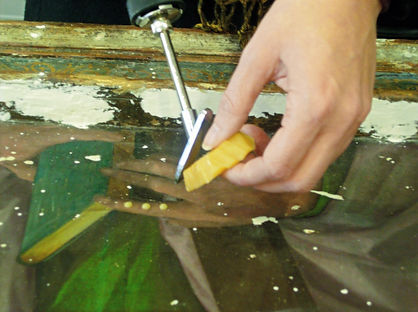
Wax Fill
When areas are very empty beneath the paint layer, it is best to treat with a wax fill otherwise the empty areas with sink or even cave in over time. In this case, a mixture of bees wax and dammar varnish is used. Wood is unpredictable and will move, crack and bend at will so it is important to use a fill that is flexible and durable but it also reversible and will not further damage the work of art. The wax applied with a heated spatula at 80 C, and very small dollops of wax are dropped onto worm holes and cracks.
Aroldyte and Stucco Reconstruction
Once the panel has been consolidated with wax, large areas of missing wood are reconstructed with aroldyte (mixed weight to weight with an “indurente” or hardening agent) then a layer of stucco is applied with a small metal spatula over the aroldyte as well as used to fill the worm holes, cracks and lacuna (holes.)


The first layer of temper must be as close to the original as possible yet cooler and lighter in shade. When all areas of gesso have been prepared with tempera color, a layer of 50% Mastic Varnish and 50% turpentine is applied with a medium size flat brush to the entire painting in preparation for the final veiling in varnish color. Once the Mastic has been allowed to dry for at least 24hrs, it is ready for the areas to be integrated in varnish color matching as closely to the original as possible without “artistically falsifying” the piece of work.